
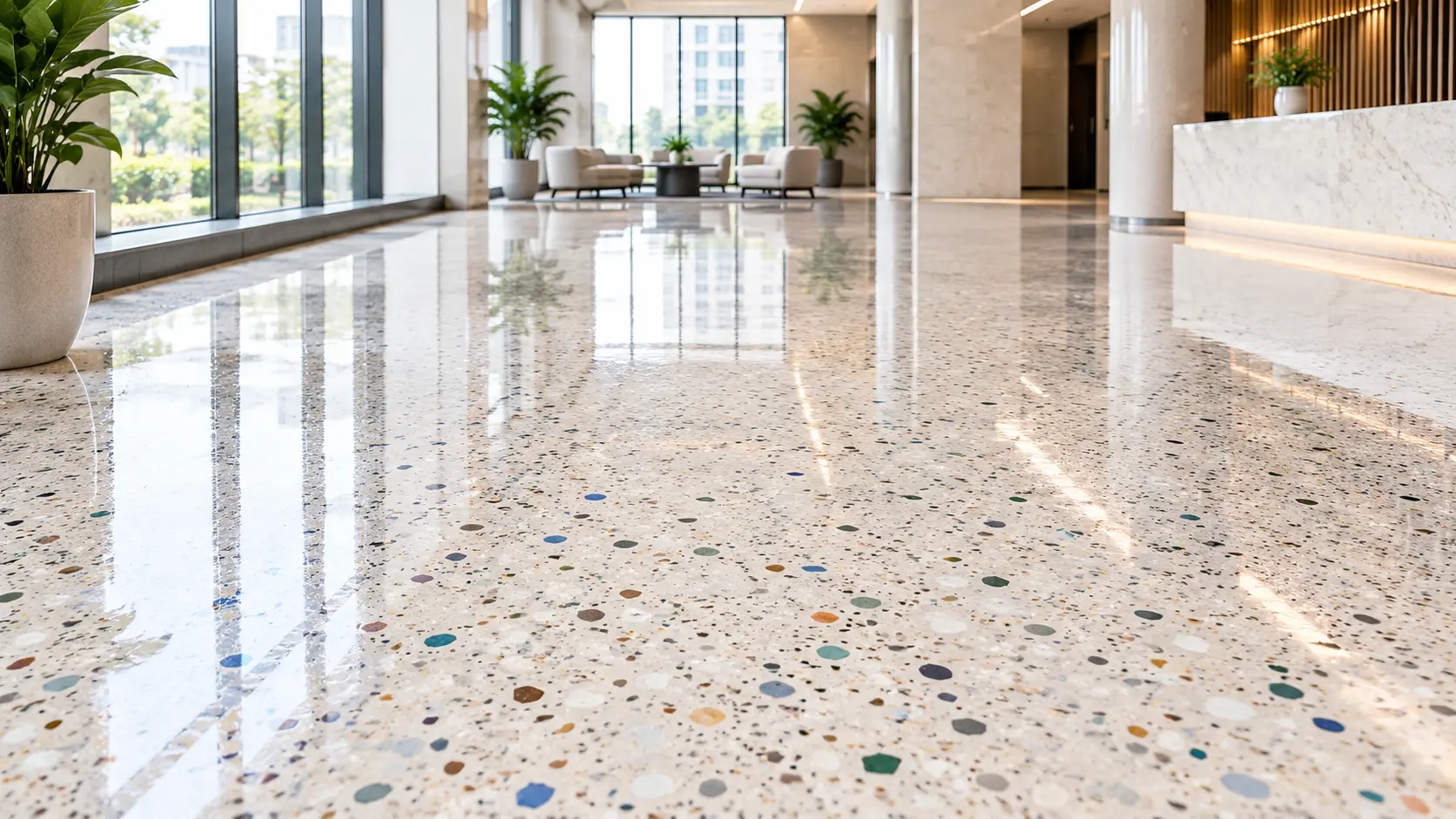
Liquid Terrazzo Flooring: Pros, Cons, Cost Factors & Care
Liquid terrazzo is a poured, seamless floor made of marble, glass or quartz chips set in epoxy resin, usually about 6 to 10 mm thick, then ground and polished. It is thinner and more colourful than cement terrazzo, costs more to install, and needs careful cleaning and periodic polishing to keep its gloss.
1. What Is Liquid Terrazzo Flooring?
Liquid terrazzo is made by combining decorative chips—often marble, glass or quartz—with an epoxy-resin binder. The mixture is poured over a prepared base, allowed to cure, then ground and polished to expose the chips. The result is a continuous surface with fewer visible joints than a tiled floor.
It is different from a standard epoxy coating, which usually creates a coloured resin layer without decorative chips. The finished look and performance depend on the materials, installation and base preparation.
2. How Is Liquid Terrazzo Installed?
Installation is a specialist process. EFCS provides floor cleaning and polishing services; we do not offer liquid-terrazzo installation. A typical installation may involve these steps:
- Inspect the base and address cracks, uneven areas and moisture concerns.
- Prepare the substrate and apply the specified primer or moisture-control system.
- Pour and spread the resin-and-chip mixture to the required thickness.
- Allow the material to cure according to the product specifications.
- Grind the surface, fill pinholes and refine the finish with finer abrasives.
- Apply the specified protective finish, if required, and follow the installer’s curing guidance.
Skipping preparation or curing steps can affect appearance and durability. Ask the installer for the product specification, maintenance instructions and a written scope of work.
3. Advantages of Liquid Terrazzo
- Seamless appearance: A poured surface can create a continuous visual effect across a room.
- Design flexibility: Different chip sizes, colours and layouts can produce distinctive designs.
- Relatively thin build: Epoxy terrazzo is often thinner than traditional cement terrazzo, although the complete floor build-up varies.
- Polishable finish: A suitable system can be ground and polished, and some surface wear may be restored professionally.
- Easy routine care: Dust mopping and appropriate neutral cleaners help maintain the surface.
4. Disadvantages and Limitations
- Installation quality matters: Poor substrate preparation or moisture control can cause failures.
- UV sensitivity: Some epoxy systems can yellow with strong sunlight; suitability depends on the resin and exposure.
- Slipperiness when wet: A high-gloss surface may become slippery when wet. Specify an appropriate finish for the location.
- Specialist repairs: Matching chips and resin during repairs can be difficult.
- Installation disruption: Preparation, curing and finishing take time; the schedule depends on the project.
- Higher initial investment: Custom designs and specialist installation can cost more than standard tile options.
5. Liquid Terrazzo vs Cement Terrazzo vs Vitrified Tiles
| Feature | Liquid epoxy terrazzo | Cement terrazzo | Vitrified tiles |
|---|---|---|---|
| Typical thickness | Often about 6–10 mm | Often around 25 mm or more | Tile commonly 8–12 mm, plus bedding |
| Joints | Few visible joints across a poured area | Divider strips are commonly used | Grout joints between tiles |
| Colour and design | Flexible chip and resin combinations | Chip and cement combinations | Factory-made tile patterns and colours |
| Crack resistance | Depends on resin system and base stability | Depends on mix, reinforcement and base | Tiles can crack if the substrate moves or installation is poor |
| Outdoor or direct sun | Some epoxy systems may yellow under UV exposure | Depends on the specification and conditions | Depends on tile rating and installation |
| Can it be re-polished? | Some systems can be professionally refinished | Usually can be ground and polished if suitable | Depends on the tile surface; many glazed tiles should not be polished like stone |
These are indicative comparisons, not specifications for every product. Actual thickness, performance and maintenance requirements vary by installer, materials and project.
6. What Affects Liquid Terrazzo Cost?
There is no reliable single price for every liquid-terrazzo floor. Ask for a site assessment and a written quotation that identifies the materials and work included.
| Factor | Why it matters |
|---|---|
| Floor area and layout | Area, room shape, edges and access affect labour and material planning. |
| Design and chip selection | Custom patterns, chip types and colour choices can change material and installation requirements. |
| Base condition | Cracks, hollows, unevenness and moisture issues may need attention first. |
| Finish and coating | Grinding level, sheen and any specified protective system affect the scope. |
| Site access | Occupied spaces, furniture, working hours and access restrictions may affect the work plan. |
| Installer and specification | System choice, workmanship, preparation and curing requirements vary. |
7. How to Clean and Maintain Liquid Terrazzo
Daily care
- Remove loose grit with a dust mop or soft-bristle broom.
- Use a microfiber mop and a pH-neutral floor cleaner diluted according to its label.
- Wipe spills promptly and use entrance mats to reduce grit.
- Use suitable furniture pads and avoid dragging heavy items across the floor.
Periodic care
When routine cleaning no longer restores the appearance, a professional assessment can determine whether machine buffing, honing or re-polishing is appropriate. The correct method depends on the resin system and the condition of the surface.
Restoration
Light surface wear may respond to suitable polishing. Chips and cracks may need filling with a compatible matching resin before refinishing. Deep damage, loose areas or a moving base require assessment; polishing alone cannot correct a structural problem.
Avoid acidic cleaners, strong alkaline products, abrasive pads and stripping chemicals unless the floor-system manufacturer specifically approves them. Test any new cleaner on a discreet area first.
8. Signs Your Floor May Need Professional Polishing
- The surface looks dull even after correct cleaning.
- Traffic paths look different from less-used areas.
- Fine scratches or scuff marks remain visible.
- The floor has a patchy sheen or residue that routine cleaning cannot remove.
- Small chips or localised wear need inspection before refinishing.
Send clear photos in natural light and describe the floor’s age, usage and cleaning products. Photos can help with an initial discussion, but they do not replace an inspection where the base or coating may be damaged.
9. Cement Terrazzo and Mosaic Floors Need Different Care
Liquid terrazzo uses epoxy resin as its binder. Traditional cement terrazzo uses cement, and older mosaic floors may have different materials and finishes. They should not automatically receive the same cleaning chemicals or polishing process.
For traditional floors, read our terrazzo floor polishing and maintenance guide and learn about our mosaic polishing service. For other floor types, compare epoxy vs concrete polishing and our floor polish comparison guide.
10. Common Maintenance Mistakes
- Using acidic or strong alkaline cleaners without checking compatibility.
- Assuming every epoxy system is suitable for outdoor or direct-sun exposure.
- Ignoring dampness, cracks or an uneven base beneath the floor.
- Applying wax or shine products that leave a film or interfere with the intended finish.
- Dragging furniture without protective pads.
- Waiting until the surface is badly worn before seeking an assessment.
11. How EFCS Can Help
EFCS provides floor cleaning and polishing services for suitable terrazzo, epoxy and concrete floors in Bangalore. We can discuss the visible condition, review photos and advise on the next step. The appropriate process depends on the floor system, its condition and the manufacturer’s guidance. EFCS does not install liquid terrazzo.
Explore our epoxy floor polishing and concrete floor polishing services, or contact us to discuss your floor.
Frequently Asked Questions
Is liquid terrazzo the same as epoxy flooring?
No. Both use epoxy resin, but liquid terrazzo includes decorative chips and is ground and polished to expose them. Standard epoxy flooring is a coloured coating without chips.
How long does liquid terrazzo last?
With routine care and periodic polishing, it can last many years. How long depends on the quality of the installation, the base, the traffic and the cleaning products used.
Can scratched terrazzo be repaired?
Often, yes. Light scratches can be removed by honing and polishing. Chips and cracks can be filled with matching resin before polishing. Deep damage or a moving base needs a closer look.
What affects the cost of liquid terrazzo?
The main factors are the area, the design complexity, the type of chips, the condition of the base slab, any levelling needed, and the finish and protective coating. A quote needs a site visit and the design.
Can liquid terrazzo be used outdoors or in direct sun?
It is generally not recommended. Epoxy can turn yellow under strong ultraviolet light. It suits indoor areas such as lobbies, offices, shops and homes.
Is liquid terrazzo slippery?
A high-gloss polished floor can be slippery when wet. Slip resistance depends on the finish, so ask your installer about a finish suited to wet or busy areas, and wipe spills quickly.
What is the difference between liquid terrazzo and cement terrazzo?
Liquid terrazzo uses epoxy resin as the binder and is much thinner. Cement terrazzo uses a cement binder, is thicker and has divider strips. Both are ground and polished, but they need different care. For cement terrazzo, see our terrazzo floor polishing and maintenance guide.
What cleaner should I use on liquid terrazzo?
Use a pH-neutral floor cleaner and a dust mop or microfiber mop. Avoid acidic and strong alkaline cleaners and stripping chemicals, because harsh products can dull the resin.
Who polishes terrazzo floors in Bangalore?
EFCS cleans and polishes terrazzo, epoxy and concrete floors across Bangalore. Call +91 89043 12966 or send photos on WhatsApp.
This guide is general information. Products and installation systems vary. Follow the floor-system manufacturer's care instructions and test any cleaner on a hidden spot first.